Instructions:
- First, read summary on page 111 and 112, from your book "Heat Transfer"
-create an electronic glossary with the following list. (the vocabulary was taken from the reading).
-Use this platform https://virtualwritingtutor.com/glossary/list for your glossary.
-Add 5 extra words or concepts from the reading (page 111 and 112 summary), which you consider important for your learning.
boundaries
Noun
A line that marks the boundaries of an area; a dividing line
Example: This period can also be described as the Early Ceramic Neolithic, the advantage of which is that it does not create BOUNDARIES and allows for continuity into the next phase, however to facilitate reference to specific groups of sites in this discussion 'Cypro-PPNB' will be used.
es: límites
Boundary
Noun
Line or set of lines that form the outline of a surface or a figure.
Example: The perimeter is the length that corresponds to the outline of a figure
es: Perímetro
Boundary conditions
Noun
a condition that is required to be satisfied at all or part of the boundary of a region in which a set of differential equations is to be solved.
Example: A boundary value problem is called the set of a differential equation and the boundary or boundary conditions.
es: Condiciones de borde
Emissivity
Noun
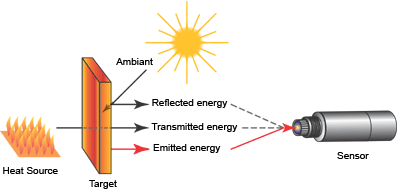
It is the proportion of thermal radiation emitted by a surface or object due to its temperature. Spectral directional emissivity is defined as the ratio between the intensity emitted by the surface in a particular direction and the intensity that would be emitted by a black body at the same temperature and wavelength.
Example: The total emissivity is obtained by integration over the entire electromagnetic spectrum and all of space.
es: Emisividad
Energy balance
Noun
Un balance de energía es una contabilidad de los aportes y del consumo de energía por parte de un sistema a estudiar. Se trata de conocer los cambios del nivel de energía de un sistema.
Example: The energy balance is the study of the energy exchange that a system has with the environment and the physical and chemical changes that this balance can bring about, which greatly alter this exchange.
es: Balance de energía
Heat conduction equation
Noun
The physical property of materials that determines their ability to conduct heat is thermal conductivity.The inverse property of thermal conductivity is thermal resistivity, which is the ability of materials to resist the passage of heat.
Example: The transmission of heat by conduction, between two bodies or between different parts of a body, is the exchange of internal energy, which is a combination of the kinetic energy and potential energy of its microscopic particles: molecules, atoms and electrons.
es: Ecuación de conducción de calor
Heat flux
Noun
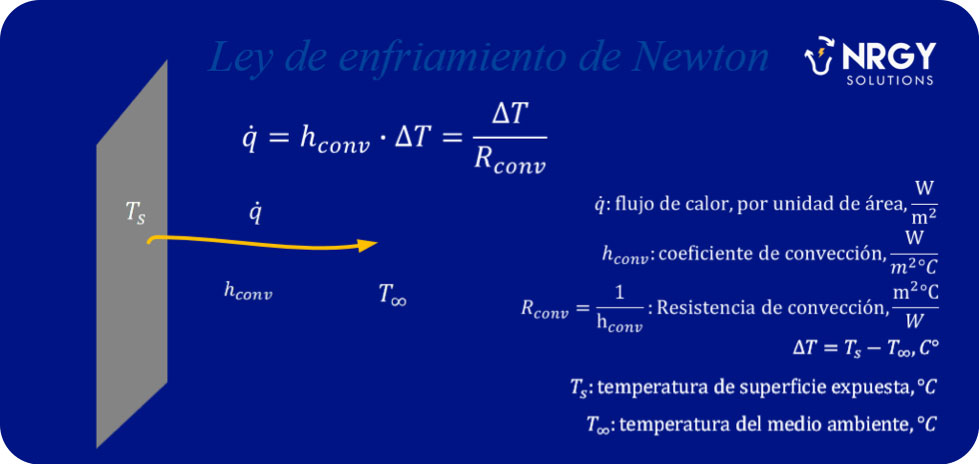
Heat flux or thermal flux, sometimes also known as heat flux density or heat flow rate intensity is a flux of energy per unit area per unit time.
Example: The heat flux (Ф) can be defined as the rate of heat energy transfer through a given surface (W), and the heat flux density (φ) is the heat flux per unit area (Wm²) .
es: Flujo de calor
Insulation
Noun
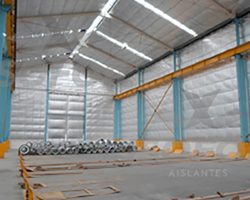
Material used to insulate something, especially a building.
Example: Wall systems columns and walls, glass construction and masonry walls Precast concrete wall panels, concrete framework, concrete columns Connections Precast concrete connections used between elements Roof systems Precast reinforced concrete roof slabs reinforced concrete roof Thermal insulation services.
es: Aislamiento
Internal energy
Noun
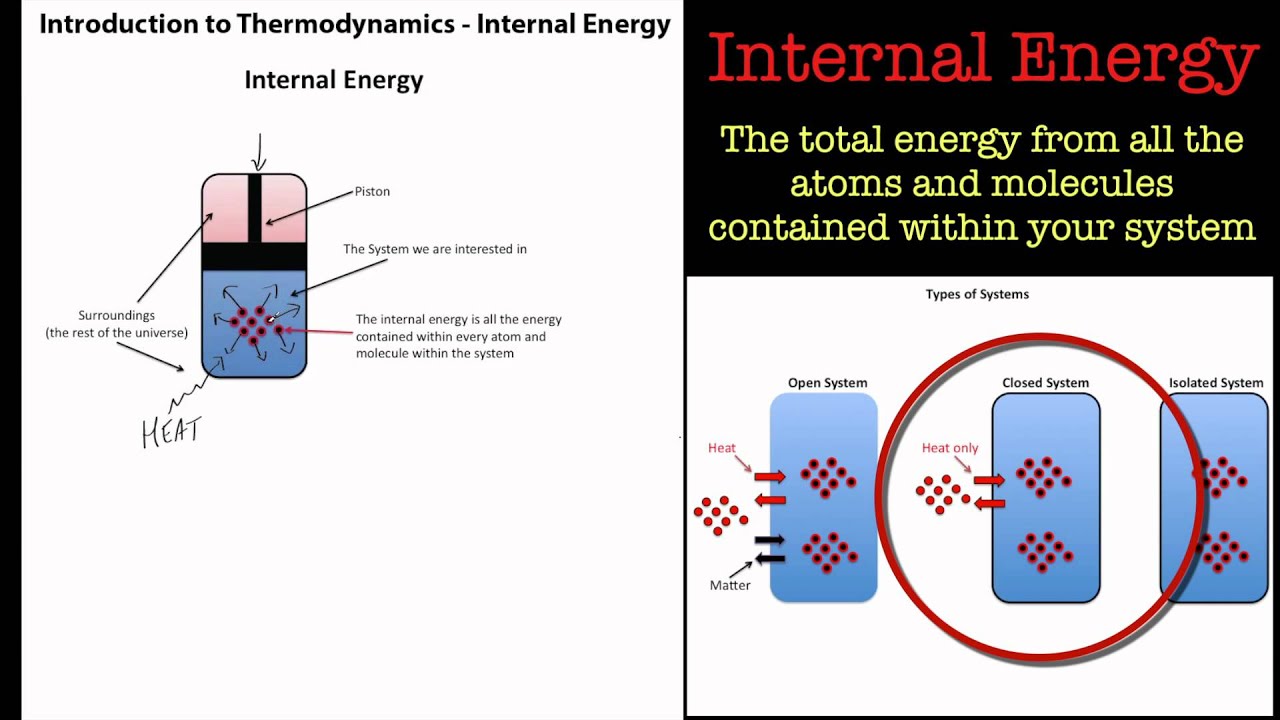
The internal energy (U) of a system is a reflection of the energy on a macroscopic scale, it is the sum of: the internal kinetic energy, that is, of the sums of the kinetic energies of the individualities that form a body with respect to the center of system Y masses
internal potential energy, which is the potential energy associated with the interactions between these individualities.
Example: The internal energy change (U) of the system is equal to the added heat (Q). If the system undergoes a temperature increase, but remains at a constant temperature, then the volume must increase. This means that the system works in its environment and the change in INTERNAL ENERGY (U) is equal to the added heat (Q) plus the work done (W).
es: Energía interna
Midsection
Noun
The middle part of something.
Example: The cutting plane reaches the middle of the part and then rotates towards the observer. The piece then appears, half in view and half in cut. This way of making the cut is very useful in the representation of symmetrical or revolution parts.
es: Sección en medio
Negligible
adjective
Unimportant as to be not worth considering
Example: However, they are useful for monitoring fitness for periods too short for genetic selection to affect the population significantly, as long as gene flow is negligible.
es: despreciable
Surrounding
Noun
all around a particular place or thing.
Example: The floors of these buildings are set at a reduced level to the surround area, as with Graubenhauser.
es: Rodeando
Thermal conductivity
Noun
Thermal conductivity is a physical property of materials that measures heat conduction capacity.
Example: Thermal conductivity is also the ability of a substance to transfer the kinetic energy of its molecules to other adjacent molecules or to substances with which it is in contact.
es: Conductividad térmica
Thermal diffusivity
Noun
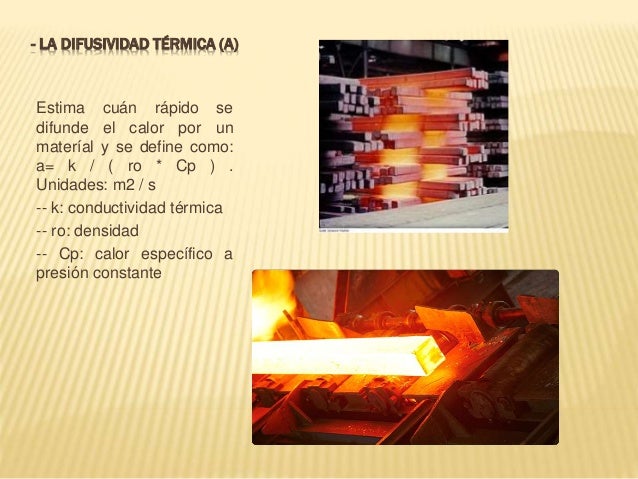
Thermal diffusivity is the thermal conductivity divided by density and specific heat capacity at constant pressure. It measures the ability of a material to conduct thermal energy relative to its ability to store thermal energy. High diffusivity means heat transfers rapidly.
Example: Initial spore load: the severity of the process dependent on the initial spore load; good factory hygiene keeps it low. Thermophysical Properties: THERMAL DIFFUSIVITY is the controlling factor.
es: Difusividad térmica
Thermal symmetry
Noun
A heat transfer problem that is symmetric about a plane, line, or point has thermal symmetry about that plane, line, or point. The thermal symmetry boundary condition is a mathematical expression of this thermal symmetry.
Example: Thermal Symmetry
Some heat transfer problems possess thermal symmetry, for example, the two surfaces of a large hot plate, of thickness L, suspended vertically in the air, will be subject to the same thermal conditions and, therefore, the temperature distribution in one of the halves of it will be the same as the other half.